
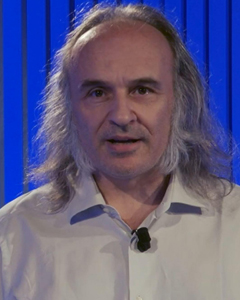
Dr. Giovanni Crisonà is an international consultant on capacity building in TVET sector, founder and Managing Director of CSCS Italy and Managing Director of Abuplus International GMBH Germany. Is a “Skill Assessor,” certified by Tuscany Region VET Authority, owns a Vocational Degree as a “Technical Director in industrial engineering” and a Master’s degree in Education. Has worked and collaborated in Europe, Africa and Asia with private bodies, governments and agencies, European Commission, ETF European Training Foundation, ITC-ILO, ADB, Millennium Challenge Corporation, regional authorities and industry leaders like FIAT Automotive, SAS Scandinavian Airlines Systems, Jaguar Land Rover and other leading European organisations.
Dr Crisonà led his organisation to be ranked, at the 10th anniversary of the EYE – Erasmus for Young Entrepreneurs network of the European Commission, as the most active Intermediary Organisation for the pèriod 2009-2019.
Presentation: From Leonardo da Vinci to Digital Badges: How Can Educators Help Build a Competence-Based Civil Society Capable of Overcoming Turbulence, Barbarism and the Law of the Strongest?
This presentation examines the evolution from historical models of skills recognition, illustrated through figures such as Brunelleschi and Leonardo da Vinci, to contemporary frameworks of competence validation through digital credentials. Starting from the European “Union of Skills” vision, it argues that success in learning must not remain the privilege of elites but become a shared right, supported by transparent and verifiable systems.
The presentation is guided by crucial rhetorical questions. At key moments, the author pauses to ask: How can educators contribute to a competence-based civil society? What lessons from history can inspire success for all? How is Skillman applying DQF.eu’s 2025 vision in schools and training institutions? These questions frame a reflective process that mirrors how the Skillman community itself engages: by questioning its role and shaping collective responses to emerging challenges.
The speech also contextualises Individual Learning Accounts (ILAs), a key European policy tool designed to give each citizen a personal training entitlement. ILAs allow learners to accumulate and carry their rights to education and training across time, providers, and even employment transitions, ensuring individual ownership and flexibility.
The second part introduces the Skillman Teacher Academy (STA) as a transnational model for applying DQF.eu’s principles, vision, and methods in schools and training institutions. While DQF.eu provides the infrastructure for transparent, blockchain-certified micro-credentials, STA focuses on equipping educators with advanced digital, green, and ethical competences, fully aligned with European frameworks such as EQF, ESCO, GreenComp, and the European Learning Model.
Finally, within STA, the emerging Skillman GenAI Academy Lab is presented as an innovation hub, where pedagogy and generative AI converge to anticipate skills needs and bridge education with labour market transformation.
Together, these initiatives illustrate how Skillman acts as a living community of practice—posing questions, co-designing answers, and enabling educators to act for a fairer and more resilient future.
Presentación: De Leonardo da Vinci a las insignias digitales: ¿Cómo pueden los educadores ayudar a construir una sociedad civil basada en competencias, capaz de superar la turbulencia, la barbarie y la ley del más fuerte?
Este discurso examina la evolución desde los modelos históricos de reconocimiento de competencias, ilustrados por figuras como Brunelleschi y Leonardo da Vinci, hasta los marcos contemporáneos de validación de competencias mediante credenciales digitales. Partiendo de la visión de la “Unión Europea de Competencias”, argumenta que el éxito en el aprendizaje no debe seguir siendo un privilegio de las élites, sino convertirse en un derecho compartido, respaldado por sistemas transparentes y verificables.
La presentación se guía por preguntas retóricas cruciales. En momentos clave, el autor se detiene para preguntar: ¿Cómo pueden los educadores contribuir a una sociedad civil basada en competencias? ¿Qué lecciones de la historia pueden inspirar el éxito para todos? ¿Cómo aplica Skillman la visión 2025 de DQF.eu en escuelas e instituciones de formación? Estas preguntas enmarcan un proceso reflexivo que refleja la participación de la propia comunidad Skillman: cuestionando su papel y configurando respuestas colectivas a los desafíos emergentes.
El discurso también contextualiza las Cuentas Individuales de Aprendizaje (ILA), una herramienta clave de política europea diseñada para otorgar a cada ciudadano un derecho a formación individual. Las ILA permiten a los estudiantes acumular y mantener sus derechos a la educación y la formación a lo largo del tiempo, con los proveedores e incluso en las transiciones laborales, garantizando la propiedad individual y la flexibilidad.
La segunda parte presenta la Skillman Teacher Academy (STA) como un modelo transnacional para aplicar los principios, la visión y los métodos de DQF.eu en escuelas e instituciones de formación. Mientras que DQF.eu proporciona la infraestructura para microcredenciales transparentes y certificadas mediante blockchain, STA se centra en dotar a los educadores de competencias digitales, ecológicas y éticas avanzadas, totalmente alineadas con marcos europeos como el EQF, ESCO, GreenComp y el Modelo Europeo de Aprendizaje.
Finalmente, dentro de STA, el emergente Skillman GenAI Academy Lab se presenta como un centro de innovación, donde la pedagogía y la IA generativa convergen para anticipar las necesidades de competencias y conectar la educación con la transformación del mercado laboral.
En conjunto, estas iniciativas ilustran cómo Skillman actúa como una comunidad de práctica activa, planteando preguntas, codiseñando respuestas y permitiendo a los educadores actuar por un futuro más justo y resiliente.